









Which Insulation Is Best for Energy Efficiency?
Introduction
Energy efficiency is important for every home. When a house loses heat, your heating system has to work harder. As a result, energy use can rise and rooms may feel cold.
The right Insulation can help reduce heat loss. It keeps more warmth inside during winter. It can also help keep your home cooler during warmer weather. Therefore, choosing the right type is an important step towards a more comfortable and energy-efficient home.
There are many insulation products available today. However, loft insulation is one of the most common options for homes.
This guide explains which Heat barrier works well for energy efficiency, what to look for, and why loft insulation can make a difference.
Why Is Insulation Important for Energy Efficiency?
Heat naturally moves from warmer areas to cooler areas. In winter, this means heat inside your home can escape through the roof, walls, floors, windows, and doors.
A large amount of heat can be lost through the roof when a loft has little or no insulation. Therefore, insulating the loft can be a simple way to reduce heat loss.
Good Insulation slows down the movement of heat.
This can help reduce the workload on your heating system. In turn, you may use less energy to maintain a comfortable temperature.
Which Type of Insulation Is Best?
There is no single product that is best for every part of a building. The right choice depends on where the material will be installed, the required thickness, the building design, and your energy goals.
For loft spaces, mineral wool products are a popular choice. They are easy to install between and over loft joists when used correctly.
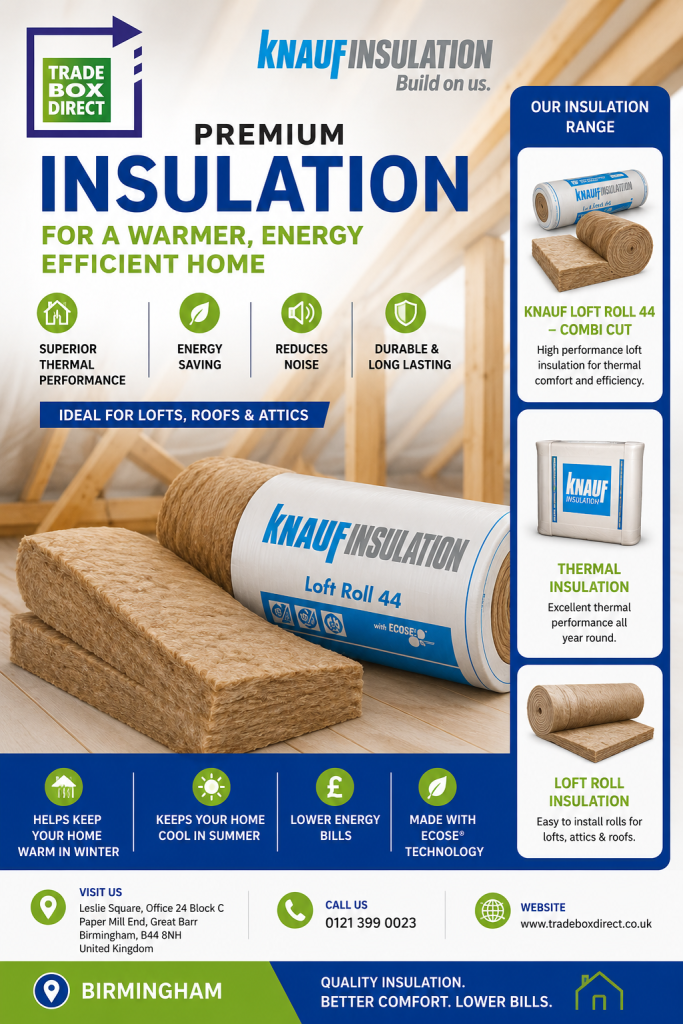
One well-known option is Knauf Loft Roll 44.
Other types include rigid boards, spray foam, sheep’s wool, cellulose, and blown mineral wool.
However, for many standard loft spaces, mineral wool rolls offer a practical balance of performance, installation, and cost.
What Is Knauf Loft Insulation?
Knauf loft insulation is designed to help reduce heat loss through the roof area.
Knauf produces mineral wool products for different building applications.
One product to consider is Knauf Loft Roll 44 – Combi Cut. It is designed for loft applications and can be cut to suit different spaces.
The material can help reduce heat transfer through the roof. Therefore, it can support a more energy-efficient home when installed correctly.
What Is Knauf Loft Roll 44?
Knauf Loft Roll 44 is a mineral wool insulation product designed for loft spaces.
The number 44 refers to its thermal insulation conductivity value. Lower thermal conductivity generally means a material provides better thermal resistance at the same thickness.
However, thickness also matters. A thicker layer usually provides greater resistance to heat flow. Knauf Loft Roll 44 100mm can be used as part of a layered loft Heat barrier system, depending on the required specification.
The correct thickness should always be based on the building requirements and current standards.
How Does Loft Insulation Save Energy?
Loft insulation works by slowing down heat movement.
Imagine your home as a warm box. Without enough insulation, heat can escape through the roof.
As a result, rooms below the loft can stay warmer for longer.
This can reduce the amount of heating needed. Therefore, Insulation can play an important role in improving energy efficiency.
However, loft insulation should not be considered on its own. Walls, floors, windows, doors, and heating controls can also affect energy use.
Knauf Insulation Roll for Loft Spaces
Knauf insulation roll is a flexible mineral wool product that can be used for suitable building applications.
Roll products are useful because they can cover larger areas. They can also be cut to fit around certain spaces.
For lofts, Knauf insulation loft roll 44 is designed to provide thermal resistance while being practical to install.
When installing a roll, it is important to avoid gaps. Even small gaps can create areas where heat can escape more easily.
Why Is Thickness Important?
Choosing Heat barrier based only on the product name is not enough. Thickness also plays a major role.
A thin layer may provide some thermal resistance. However, a thicker layer can provide greater resistance to heat flow.
For example, Knauf Loft Roll 44 100mm provides a 100mm layer. Additional layers may be required to reach the desired total depth.
In many loft installations, insulation is placed between the joists first.
This second layer helps reduce thermal bridging through the timber.
However, the exact design should follow the relevant building requirements.
Earthwool Loft Insulation
You may also come across Earthwool loft insulation when comparing products.
Earthwool is a mineral wool Heat barrier range designed for different building applications.
Like other mineral wool products, it can provide thermal resistance when installed at the correct thickness.
When comparing products, look at thermal conductivity, thickness, fire performance, installation method, and the intended application.
Price is also important. However, choosing a product based only on the lowest price may not provide the best long-term result.
Benefits of Good Loft Insulation
Good loft Temperature control can provide several benefits.
1. Less Heat Loss
First, it slows down heat escaping through the roof. This can help your home retain warmth.
2. Lower Energy Use
Because less heat escapes, your heating system may not need to run as often.
3. Better Comfort
Rooms below the loft can feel more comfortable. Cold ceilings and rooms can become less of a problem.
4. Long-Term Value
A properly installed Temperature control layer can continue to provide thermal benefits for many years.
5. Better Energy Efficiency
Finally, reducing heat loss can improve the overall energy efficiency of the building.
For these reasons, Insulation is an important part of many home energy-saving plans.
How to Install Loft Roll Correctly
Correct installation is just as important as choosing a good product.
First, measure the loft area. Next, check the required Temperature control depth.
Then, place the first layer between the joists. Make sure the material fits closely without large gaps.
After that, a second layer can be installed across the joists when required.
Avoid compressing the material more than the manufacturer allows. Compression can change the product’s designed performance.
Also, do not block important ventilation routes. Roof spaces need suitable airflow to help manage moisture.
Therefore, installation should balance thermal performance with safe roof-space ventilation.
Common Mistakes to Avoid
Several mistakes can reduce the performance of loft Temperature control.
Leaving Gaps
Gaps can allow heat to escape. So, make sure the material covers the required area properly.
Using the Wrong Thickness
A product that is too thin may not provide the required thermal performance.
Compressing the Material
Excessive compression can affect its performance.
Blocking Ventilation
Do not cover ventilation paths in the roof. Good airflow helps protect the roof space from moisture problems.
Ignoring Other Areas
A well-insulated loft will help, but heat can still escape through walls, floors, windows, and doors.
Therefore, consider the whole building when improving energy efficiency.
Is Knauf Loft Roll 44 a Good Choice?
Knauf Loft Roll 44 can be a good option for suitable loft applications.
The Knauf Loft Roll range can also be useful when working across larger loft areas.
However, the best product depends on your property. Before buying, check the required thermal performance, thickness, coverage area, and installation requirements.
If you are unsure, speak with a qualified building professional.
How to Choose the Best Insulation for Your Home
When choosing Temperature control, consider several factors.
First, decide where the material will be installed. Loft insulation is different from wall or floor insulation.
Next, check the thermal conductivity. A lower value generally means better thermal performance at the same thickness.
Then, consider the required thickness. A suitable product at the correct thickness is more important than choosing a product simply because it has a familiar brand name.
Also, check fire performance, moisture resistance, durability, and installation requirements.
Finally, compare the total cost. This includes the product, installation, and any additional materials.
With these points in mind, choosing the right Temperature control becomes much easier.
Can Insulation Help Reduce Heating Costs?
Yes, insulation can help reduce heat loss. As a result, your heating system may need less energy to maintain the desired temperature.
However, the amount you save depends on several factors.
Therefore, it is better to think of insulation as one part of a complete energy-efficiency plan.
Combining good loft insulation with efficient heating controls, draught reduction, and suitable windows can produce better results.
Final Thoughts
So, which insulation is best for energy efficiency?
For many loft spaces, mineral wool rolls are a practical and effective choice. Products such as Knauf Loft Roll 44 – Combi Cut, Knauf insulation roll, and Earthwool loft insulation can provide good thermal performance when selected and installed correctly.
The key is not simply choosing a product. Thickness, coverage, installation quality, and the condition of the building all matter.
A properly insulated loft can slow heat loss, improve comfort, and support lower energy use. Therefore, investing in good Insulation can be a useful step towards a more energy-efficient home.
Before starting work, always check the manufacturer’s instructions and current building requirements. If the project is complex, professional advice can help you choose the right product and installation method.
Frequently Asked Questions
1. What is the best insulation for energy efficiency?
For many loft spaces, mineral wool rolls are a practical choice. Knauf Loft Roll 44 is one option that can provide good thermal performance when installed at the correct thickness.
2. Is Knauf Loft Roll 44 good for a loft?
Yes. Knauf Loft Roll 44 is designed for loft applications. It can be used between and over joists, depending on the installation design.
3. Is thicker insulation better?
Generally, increasing thickness increases thermal resistance. However, the correct depth depends on the building, available space, and required thermal performance.
4. What is Knauf insulation roll used for?
Knauf insulation roll products are used for different building applications. Specific products should be selected based on the area being insulated and the manufacturer’s guidance.
5. Can loft insulation reduce energy bills?
It can reduce heat loss, which may lower the energy needed for heating. However, actual savings depend on the property and other factors.